Trichomes Are the Resin Glands That Coat Cannabis Flower
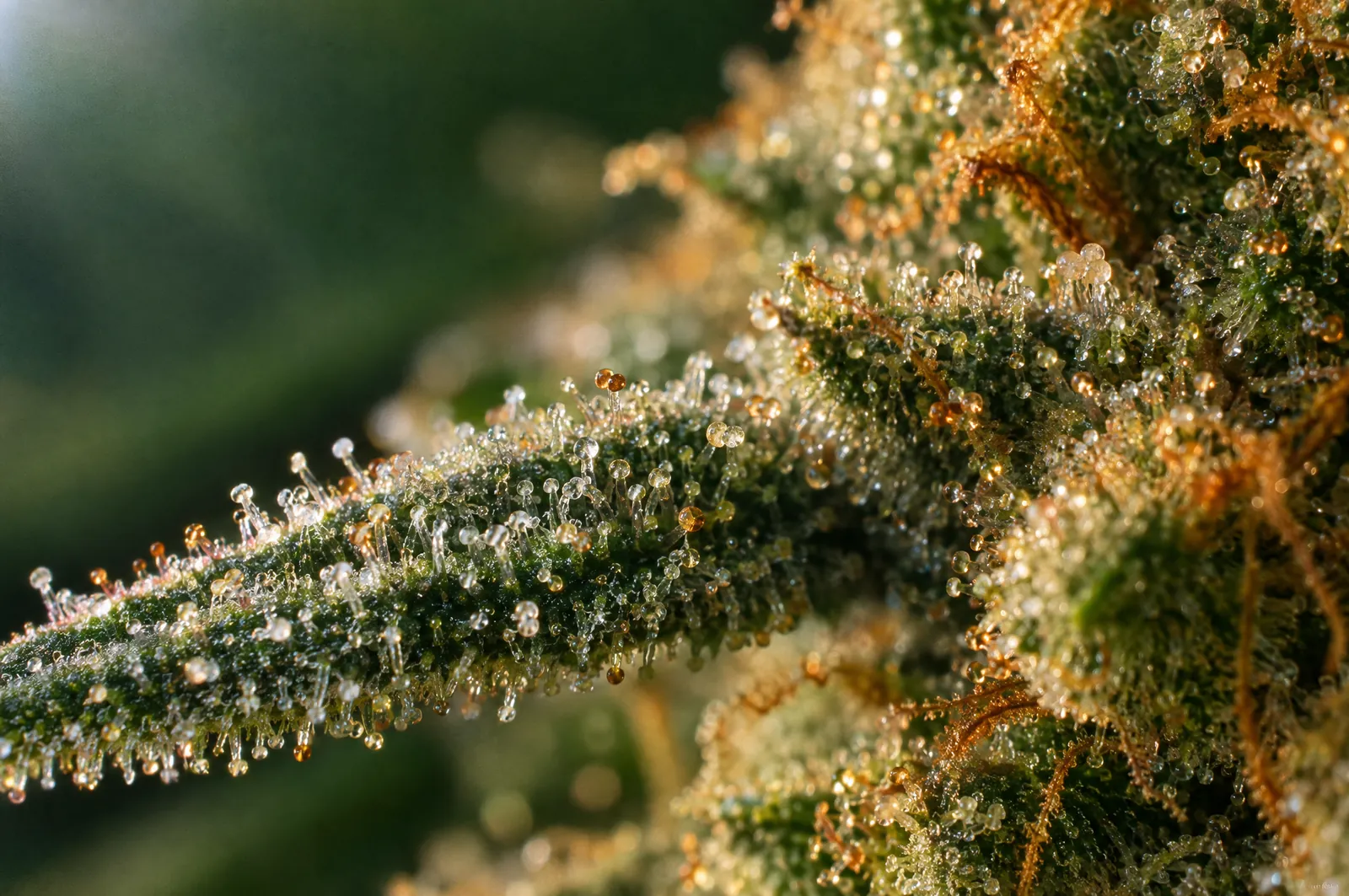
A trichome is an outgrowth of the plant's outer surface. On cannabis, the glandular kind that matters most to shoppers looks like a translucent stalk capped by a round head, similar in shape to a pin or a mushroom. They cluster most densely on the small bracts that make up the flower and on the sugar leaves immediately around them. Fan leaves and stems carry far fewer.
Inside the head sits a layer of secretory cells that build cannabinoids and terpenes and push them into a cavity beneath the outer cuticle. That cavity is the resin reservoir. When you rub a bud between your fingers and it turns sticky and sharply aromatic, you are rupturing trichome heads and releasing what was stored in them.
Botanists generally describe these glands as a defensive adaptation. The resin and its aromatic compounds are widely associated with deterring insects and shielding developing seed tissue from ultraviolet light. For a shopper, the practical takeaway is simpler: the frost you see is where the plant concentrated most of what you are buying flower for.
Cannabis Produces Three Main Glandular Trichome Types
Bulbous trichomes are the smallest, commonly reported at roughly 10 to 30 micrometers, which is well below what your eye can resolve. They sit almost flush with the plant surface and consist of only a few cells. They appear across much of the above-ground plant but contribute a small share of total resin.
Capitate-sessile trichomes are larger, often described in the range of 25 to 100 micrometers, with a visible head resting directly on the surface with little or no stalk. They are numerous on leaves and bracts. Capitate-stalked trichomes are the ones that create the visible frost. Their stalks can reach several hundred micrometers, and their heads are the largest of the three, which is why they dominate a bud's appearance under magnification.
Cannabis also grows non-glandular trichomes, which are simple hair-like projections with no resin head. They add texture but not chemistry. When a grower or a budtender talks about trichome development, they are almost always talking about the capitate-stalked glands on the flower itself.
Growers Watch Trichome Color to Time the Harvest
Trichome heads change appearance as the flower matures, and cultivators use that change as a harvest signal. Early heads look clear or glassy. As the flower advances, many heads turn cloudy or milky. Later still, some shift toward amber or brown, a change usually attributed to oxidation and degradation of the resin. Growers inspect with a jeweler's loupe or a handheld microscope because these differences are invisible without magnification.
Researchers who tracked cannabis glandular trichomes through flower maturation reported that gland morphology and the metabolite content inside the heads both change over the maturation window. That work is part of why color inspection is treated as a standard field practice rather than folklore, though the visual cue remains an approximation rather than a direct read of what is inside the gland.
There is no single correct ratio of clear to cloudy to amber. Cultivars mature at different rates, and a grower may pull a crop earlier or later based on the profile they are aiming for and the demands of their harvest schedule. Packaged flower on a dispensary shelf will typically show a mixture, and that mixture alone does not tell you whether the flower was grown or cured well.
Trichome Coverage Reflects Handling and Cure, Not Just Genetics
Trichome heads are fragile. They break off under friction, heat and pressure. Between harvest and the jar in your hand, flower gets hung, dried, trimmed, cured, weighed, packaged and shipped, and every one of those steps can knock glands loose. Machine trimming is generally rougher on trichomes than careful hand trimming, and overpacked containers compress buds against each other.
That is why loose resin dust settling at the bottom of a container is worth noticing. It means heads have detached. A small amount is normal in any packaged flower. A thick layer, combined with buds that look bare or polished in spots, suggests the product took more physical handling than ideal.
Storage matters after purchase as well. Heat, direct light, dry air and repeated handling all accelerate the breakdown of resin and cause more heads to shed. Keeping flower in a sealed opaque container at stable room temperature, and handling it as little as possible before use, preserves the glands you paid for.
How to Judge Trichomes on a Dispensary Shelf
Start with light. In good lighting, mature flower with intact glands throws a distinct glitter that moves as you rotate the bud or the photo. Flat, matte-looking flower with no sparkle usually means either an immature harvest or heavy resin loss in handling. Many menu listings include close-up product photography that shows this clearly.
Then look at distribution. Frost that runs across the whole bud surface, including down into the crevices between bracts, reads differently than frost concentrated only on the outer tips. Also look at the structure underneath. Buds that have been compressed flat, or that show broken and shiny facets, have likely lost surface glands regardless of how they were grown.
Keep trichome appearance in proportion. It is one signal among several, alongside aroma, moisture, trim quality, bud structure and the lab data on the package. Visible frost does not by itself predict how a given product will suit you, and it is not a substitute for asking a staff member what a specific batch is like.
Looking at Flower in Person at One Green Leaf in Gibbsboro
One Green Leaf is a licensed adult-use cannabis dispensary in Gibbsboro, New Jersey, in Camden County, about 30 minutes from Philadelphia, operating under NJ CRC license RE000846. The store is open every day from 9 AM to 9 PM. You must be 21 or older with a valid government photo ID, and no medical card is required.
If examining flower closely matters to you, shopping in store gives you the most to work with, since you can ask questions before you decide. One Green Leaf also offers drive-thru pickup and reserve-ahead pickup, so another approach is to browse the live menu, reserve what interests you, and look at it when you collect the order.
The full menu runs on Dutchie and updates in real time, covering flower, vapes and carts, edibles, pre-rolls, concentrates and a wellness category with tinctures and topicals. Because selection changes throughout the day, check the live menu for what is actually in stock rather than relying on any static list.
Researchers tracking cannabis glandular trichomes through flower maturation reported that trichome morphology and the metabolite content stored inside the gland heads both change measurably as the flower matures.