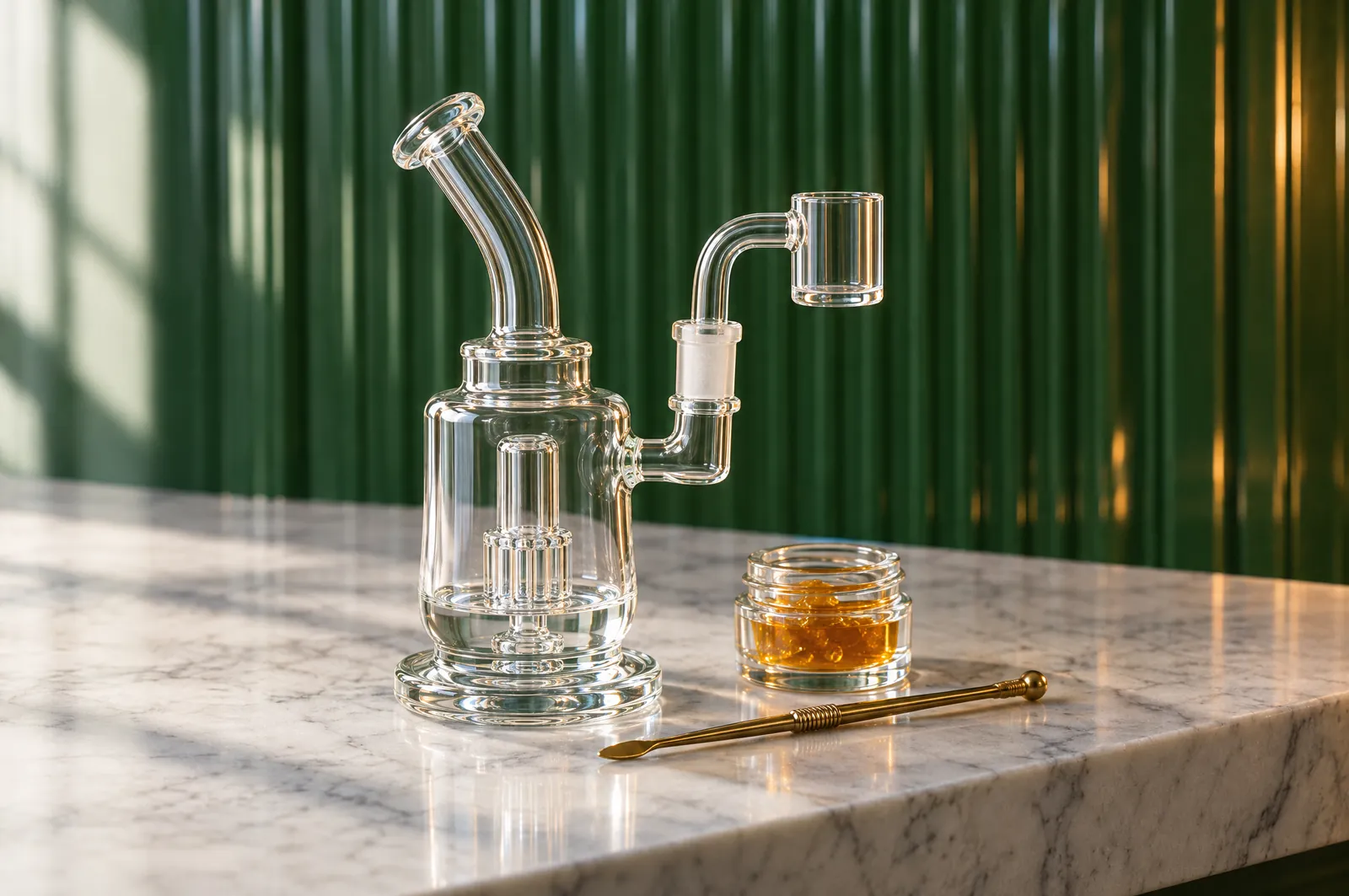
A dab rig is a water pipe built for concentrates instead of flower
The mechanical difference between a dab rig and a standard flower water pipe comes down to how heat reaches the material. A flower pipe holds ground plant material in a bowl that you light directly. A rig has no bowl in that sense. It has a nail or banger, a thick piece of quartz, glass, ceramic or titanium that you heat first, then touch the concentrate to. Nothing is set on fire, and the concentrate turns to vapor on contact with the hot surface.
Rigs are also usually smaller than flower pipes. The path from the nail to the mouthpiece is short and the water chamber holds less water. Concentrate vapor is dense and cools quickly, and a long path with heavy filtration tends to strip flavor out of it, so most rigs keep the geometry tight and the percolation simple. That is a design choice about flavor, not about strength.
Materials vary by preference. Quartz is the most common banger material because it heats fast and carries flavor well. Ceramic holds heat longer but takes more time to come up to temperature. Titanium is durable and hard to break, though many concentrate shoppers find it changes the taste. None of these is a required upgrade over the others.
The four parts that make a dab rig work
The nail or banger is the heated surface where the concentrate is placed. A banger is the bucket shaped version most people use today, with a flat bottom and a raised wall that holds the material as it melts. It sits in the rig's joint the way a bowl would. Bangers come in different wall thicknesses, and thicker walls hold heat longer while taking longer to reach temperature.
The carb cap is the small lid you place over the banger after applying the concentrate. It restricts airflow, which lowers the pressure inside the banger and lets the concentrate vaporize at a lower temperature. Directional and bubble caps also let you move the puddle of concentrate around the hot surface so it vaporizes evenly instead of pooling in one cold spot.
The heat source is either a butane torch or an e-nail. A torch is the traditional method, inexpensive and portable, and it requires you to heat the banger and then wait for it to cool to a usable temperature. An e-nail is an electric coil wrapped around the banger with a controller that holds a specific temperature, which removes the guesswork and the timing. Below both sits the water chamber, which cools and lightly filters the vapor before it reaches the mouthpiece.
How a dab session works from heat-up to cool-down
A session with a torch follows a simple sequence. You fill the rig's chamber so the downstem is submerged but not flooded, heat the banger with the torch until it is very hot, remove the flame, and then wait. The wait is the part new users skip. Depending on the banger's thickness, that cool-down commonly runs somewhere between about 30 and 60 seconds, and many people use a timer or an infrared thermometer rather than guessing.
Once the banger has cooled to the target range, you apply a small amount of concentrate with a dab tool, set the carb cap over the top, and inhale slowly while spinning or rocking the cap. Slow, steady airflow keeps the temperature stable and gives the material time to vaporize fully. When the vapor stops, you remove the cap and swab the banger with a cotton swab while it is still warm, which keeps residue from carbonizing and affecting the next dab.
Portion size deserves attention because concentrates are a different format than flower. A typical dab is very small, often compared to a grain of rice or smaller. People new to concentrates commonly start well under that amount, wait, and adjust from there. That is general guidance about an unfamiliar product format, not a recommendation about any outcome.
Low-temperature and high-temperature dabbing change flavor and vapor
Dab temperature is a spectrum, not a switch, and the difference shows up mainly in flavor and in how the vapor feels. Lower temperature dabs, taken well after a banger has stopped glowing, tend to produce thinner, cooler vapor and let more of the terpene aroma come through, which is why flavor focused users gravitate toward that end. The tradeoff is that some material may be left behind in the banger, which is what the carb cap and a slow draw help address.
Higher temperature dabs vaporize the material immediately and produce thicker, hotter vapor. That is faster and leaves less residue, but the aromatic compounds that carry flavor break down at those temperatures, so the taste flattens and the vapor is noticeably harsher on the throat. Researchers studying dabbing have also reported that heating cannabis terpenes to high temperatures can generate degradation byproducts, which is one reason the wider concentrate community has moved toward lower temperatures over the past several years.
In practice, most people land somewhere in the middle and adjust based on the concentrate itself. A terpene rich live resin or a fresh rosin generally shows its aroma best at the cooler end. A firmer, less aromatic extract may need a bit more heat to vaporize cleanly. Working through that range with small dabs is how you find a setting you like.
Dab rigs and portable dab pens suit different shoppers
A dab rig is a stationary glass setup. It requires a torch or an e-nail, a dab tool, a carb cap and water, it stays where you set it up, and it takes a minute or two of preparation per session. What you get in exchange is granular temperature control, a fully visible process, and water cooled vapor that concentrate shoppers generally consider the most flavor forward way to take a dab. There is also cleaning, since bangers and water need regular attention.
A dab pen is a battery powered pocket device with a small internal chamber that you load with concentrate, or a prefilled concentrate cartridge that threads onto a battery. There is no torch, no water and no timing. You press a button and inhale. The chamber is smaller, temperature settings are preset rather than fine tuned, and the vapor is not water cooled, so the flavor profile is different and the format is far more convenient.
Neither format is the better one. If you care most about flavor detail, want to control temperature closely, and are shopping for something you will use at home, the rig is the setup built for that. If you want something that fits in a pocket, requires no accessories and works in a few seconds, a pen or a cartridge is the practical answer. Plenty of concentrate shoppers keep both and choose by situation.
Where concentrates fit on the One Green Leaf menu in Gibbsboro
Concentrates are one of the categories One Green Leaf carries, alongside flower, vapes and carts, edibles, pre-rolls and wellness products including tinctures and topicals. On the live Dutchie menu, concentrates are listed by product type, so textures and formats such as live resin, badder, sugar, sauce and rosin are listed separately when they are in stock. Because the menu updates in real time, it is the only accurate source for what is available on a given day, and we do not quote prices or availability outside of it.
One Green Leaf is a licensed adult-use dispensary, so no medical card is required. You must be 21 or older with a valid government issued photo ID. We are open every day from 9 AM to 9 PM under New Jersey CRC license RE000846, and you can shop in store, use the drive-thru for pickup, or reserve ahead online.
Hardware is a separate question from cannabis products. Accessory selection varies and we do not claim to stock any particular rig, banger, cap or torch, so check the live menu to see what is listed rather than assuming. If you are new to concentrates, the staff at the Gibbsboro counter can walk you through how the different textures on the menu are made and which formats work with which devices.
Researchers examining dabbing reported that heating cannabis terpenes to high temperatures can produce degradation byproducts, which is part of why lower temperature dabbing became the common recommendation.