What Hybrid Weed Actually Is
Hybrid weed is cannabis produced by breeding a plant from indica lineage with a plant from sativa lineage, so the offspring inherits traits from both parent lines. The word describes ancestry. It is a statement about where a plant came from, not a promise about what a given package will contain or how any individual will respond to it.
The botanical background matters here, because the everyday vocabulary is looser than the science. Indica and sativa function in retail as vernacular names for two broad populations that were historically separated by geography and growing conditions. Plants from the indica pool were typically described as shorter and broader-leaved with a compact growth habit and a shorter flowering period, while the sativa pool was described as taller and narrower-leaved with a longer flowering period. Those were morphological and agronomic descriptions first, written by botanists looking at plants, and only later did the retail market repurpose them as shorthand for expected experience.
In a dispensary, the correct unit of information is the cultivar, sometimes called the strain. A cultivar is a named, cultivated selection that growers propagate deliberately, usually from clones, so that the plant stays consistent from one crop to the next. GMO Cookies is a cultivar. Hybrid is the box that cultivar gets sorted into. Two products can both say hybrid on the shelf tag and be almost nothing alike in aroma, cannabinoid content or terpene composition, because the box is much wider than the plant inside it.
Where the Indica and Sativa Vocabulary Came From
The names are far older than the dispensary. Carl Linnaeus named Cannabis sativa in Species Plantarum in 1753, working from European hemp grown for fiber and seed. Jean-Baptiste Lamarck described Cannabis indica in 1785 from Indian material, distinguishing it on the basis of its firmer stem, narrower leaflets and poorer fiber quality. A third name, Cannabis ruderalis, was applied by Dmitrij Janischewsky in 1924 to wild-growing populations in Russia. Every one of those descriptions was about plant form and agricultural use. None of them was a claim about how a person would feel.
Botanists have never fully agreed on how many species there are. Schultes and colleagues argued in the 1970s, after field work in Afghanistan, for recognising multiple species, while Small and Cronquist proposed treating cannabis as a single polytypic species, Cannabis sativa L., divided into subspecies. That disagreement has never been settled, and modern genetic work has complicated it further rather than resolving it. Anyone who tells you the species question is closed is overstating the record in one direction or the other.
Ruderalis is worth knowing about for one practical reason. Those populations flower according to plant age rather than day length, a trait called day-neutral or autoflowering. Breeders crossed that trait into drug-type cultivars, which is why autoflower seed lines exist. It is a breeding tool, not a third shelf category, and you will rarely see the word on a retail menu.
The retail mapping, where indica means one kind of evening and sativa means another, was layered on much later by sellers and by consumer folklore as underground and then legal markets grew. It was a convenient way to talk to customers. It was never a finding that botanists produced, and it does not follow from the plant names or from the original descriptions.
Why Almost All Modern Cannabis Is Technically a Hybrid
The clean split between indica and sativa collapsed decades ago. Through the second half of the twentieth century, breeders crossed imported landrace populations from different regions with each other, then crossed the results again, largely outside of any formal record-keeping system. By the time legal markets began keeping documentation, the gene pool had already been mixed thoroughly. A genuinely unmixed landrace population is rare in regulated retail, and most of what is advertised as pure indica or pure sativa is better understood as strongly leaning in one direction.
Researchers have looked at this directly. Genetic work published by Sawler and colleagues in PLOS ONE in 2015 compared the reported ancestry of commercial cannabis samples against their measured genetic structure and found that the correspondence was only moderate. Plants marketed as sativa sometimes clustered genetically with indica-labeled material and the reverse also occurred. In other words, the ancestry claims attached to commercial cultivars were often inconsistent with the genetics of the plants themselves.
For a shopper, the practical consequence is simple. When a menu sorts inventory into indica, sativa and hybrid, it is applying an inventory convention that grew out of tradition and habit rather than a measurement. It is a useful way to organize a wall of product names, and budtenders and customers share the vocabulary, so it is not useless. It is just not the layer where the real information lives.
The Three Shelf Labels: Indica-Dominant, Sativa-Dominant and Balanced
Most New Jersey menus split the hybrid category three ways. An indica-dominant hybrid is a cross whose reported parentage leans toward indica lineages. A sativa-dominant hybrid leans the other way. A balanced or 50/50 hybrid is one whose reported parentage is roughly even between the two pools. You will often see this expressed as a ratio such as 70/30 or 60/40 next to the cultivar name.
It is worth being precise about where those numbers come from. They are almost always breeder-supplied, calculated from the stated parentage of the cross and passed down the supply chain from breeder to cultivator to menu. They are not the output of a laboratory test, and no standards body verifies them. Two vendors selling the same cultivar can list different ratios, and the same cultivar can be tagged indica-dominant on one menu and balanced on another. Treat the ratio as a piece of provenance, similar to a note about a wine's grape blend, rather than a specification.
What the label genuinely does tell you is which broad family of aroma and structure a cultivar tends to belong to, and which conversational shorthand a budtender will use when comparing options. Products in these three groups are often described in different terms by consumers, and those descriptions circulate widely. Just recognize that the description is a convention people have inherited, and the actual chemistry printed on the batch report is what varies from one package to the next.
How Hybrids Are Bred
Breeding a hybrid starts with parent selection. A breeder picks a mother plant and a father plant chosen for specific traits: aroma compounds, flower structure, resin production, flowering time, mold resistance, yield or cannabinoid ratio. Cannabis is normally dioecious, meaning male and female flowers occur on separate plants, so the breeder collects pollen from the selected male and applies it to the flowers of the selected female. The seeds that result are the first filial generation, usually written as F1.
In classical plant breeding, an F1 generation is uniform because both parents are highly inbred and genetically consistent. Cannabis rarely works that way. Very few cannabis parent plants are true-breeding inbred lines, so F1 populations commonly show real variation from seed to seed, and that variation widens further in the F2 generation when parental traits recombine. This is why phenotype hunting in cannabis usually begins right at F1 rather than waiting. A breeder may germinate hundreds or thousands of seeds, grow them out, and evaluate each individual plant, or phenotype, for the exact combination of traits wanted. Most are discarded. The few keepers are the plants that will define the cultivar. That is why you sometimes see a cultivar name followed by a number, such as a cut labeled number 4 or number 7, which identifies which selected phenotype a grower is running.
From there, breeders use two main tools. Backcrossing means crossing a selected offspring back to one of its own parents, repeatedly, to concentrate a desirable trait from that parent and make it appear reliably in the population. Stabilizing means selecting and inbreeding across several generations until seeds from the line consistently produce plants with the intended characteristics, which takes many cycles and is one reason truly stable seed lines are less common than the marketing suggests. Once a single outstanding phenotype is identified, most commercial cultivators stop using seed entirely and propagate that plant by cloning, taking cuttings so that every plant in the room is a genetic copy. That is how a named cultivar stays recognizable across harvests and across growers.
Why the Cultivar and Its Chemovar Matter More Than the Hybrid Label
The most useful concept for a modern shopper is the chemovar, a plant classified by its measured chemical composition rather than by its appearance or its family story. Chemists including Arno Hazekamp and Justin Fischedick argued in Drug Testing and Analysis that cannabis should be described by chemotype and chemovar rather than by informal strain names, because the chemical fingerprint is measurable and the names are not. A chemovar description covers the cannabinoids present, principally THCA and its decarboxylated form THC, plus CBD, CBG, CBN and minor cannabinoids, together with the terpene profile: compounds such as myrcene, limonene, beta-caryophyllene, alpha-pinene, linalool, terpinolene, humulene and ocimene, which account for most of what you smell.
This is where the honest answer about the indica and sativa framework sits. In a 2022 PLOS ONE analysis of commercial cannabis samples in the United States, Smith, Vergara, Keegan and Jikomes reported that products fell into a small number of chemical groups defined mainly by their dominant terpenes, and that these groups cut straight across the indica, sativa and hybrid labels applied at retail. Samples marketed under the same category frequently had different chemistry, and samples in different categories frequently had similar chemistry. That finding is the single most important thing to understand about the hybrid label: the category is a weak predictor of what is actually in the jar.
Two further points keep this accurate rather than overcorrected. First, the popular idea that terpenes and cannabinoids interact to shape experience, often called the entourage effect, remains a hypothesis under active investigation rather than settled science. Researchers including Ethan Russo have proposed detailed mechanisms, while other groups have published laboratory results that did not support them, and the question is not resolved. Second, even a complete chemical profile does not determine an individual outcome, because dose, product format, frequency of use, tolerance, individual physiology and setting all vary from person to person. The reasonable conclusion is not that labels mean nothing, but that the cultivar name plus the batch lab data is a far better guide than the three-way category, and that no data set on a label can promise a result.
How to Read a Hybrid Label in a New Jersey Dispensary
Adult-use cannabis sold in New Jersey is tested by a licensed laboratory and labeled under rules set by the Cannabis Regulatory Commission, so every package carries a consistent set of data points. Start with the cultivar name and the product category, because those two together identify what you are buying. Flower, pre-rolls, vape cartridges, edibles and concentrates all report their contents differently, and the same cultivar name on a cartridge and on a jar of flower will not have the same composition.
Next look at the cannabinoid figures. Flower and concentrates are typically expressed as a percentage of weight, while edibles and beverages are expressed in milligrams per serving and per package. One detail that trips up a lot of shoppers is the difference between THCA and total THC. Raw cannabis contains mostly THCA, an acid form that converts to THC when heated. Labs calculate total THC using the accepted conversion, total THC equals THCA multiplied by 0.877 plus any delta-9 THC already present, which accounts for the mass lost during that conversion. A label listing a high THCA figure and a lower total THC figure is not an error, it is the same material described two ways. Read the number for what it is: a compositional fact, not a quality score, and not a ranking of one product over another.
Then read the parts most people skip. The terpene list, when a producer publishes one, is the closest thing on the package to a description of what you will actually smell and taste, and it is measured rather than asserted. The batch or lot number ties the package to a specific harvest and a specific certificate of analysis, which usually also reports testing for pesticides, heavy metals, residual solvents and microbial contaminants. Package or harvest dates matter because terpenes are volatile and a profile changes as flower ages. The cultivator name is worth noting too, since the same cultivar grown by two operators can test quite differently. Finally, every compliant package carries the warnings and symbol required by the state, and staff can pull up the certificate of analysis if you want to see the full report.
Named Hybrid Examples Sold in New Jersey
The following cultivars were observed on One Green Leaf's live menu in a capture dated July 6, 2026, and they are named here as real examples of hybrids that circulate in the New Jersey market. Availability changes constantly, so treat this as illustration rather than inventory. The live menu shows what is actually available right now, and it updates in real time. Each cultivar below is described by lineage and aroma only, which are the two things that can be stated without speculating about outcomes.
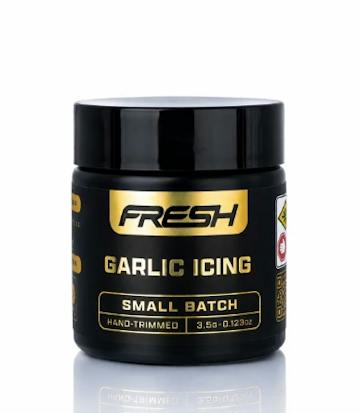
GMO Cookies, also written as GMO or Garlic Cookies, is widely reported as a cross of Chemdawg and Girl Scout Cookies. It is known for a savory profile, with garlic and onion notes over a coffee and diesel base, which is unusual in a market dominated by sweet and fruit-forward aromas. Apple Fritter is commonly reported as Sour Apple crossed with Animal Cookies, and it leans pastry-sweet, with baked apple and a doughy, slightly earthy finish. Rainbow Belts is reported as a cross in the Zkittlez and Moonbow family and is named for its candy character, with sweet tropical fruit and a sharp sugar-shell top note. Gobstopper, released through Compound Genetics, sits in the grape and fuel family, pairing dark berry sweetness with a solvent-like sharpness.
GovernMint Oasis is also reported as a Compound Genetics release and is mint-forward, with cool herbal and menthol notes over a sweet cookie base. PB & J is named for its aroma rather than its parentage, combining a nutty, roasted character with jammy berry sweetness. Don Mega is typically described in candy and gas terms, with sweet fruit sitting over a heavier, pungent base. Lemon Berry Kush reads much as its name suggests, with bright citrus peel and berry layered over the earthy, slightly piney character associated with kush lineages.
One honest caveat applies to all of these. Breeder-reported parentage is self-reported and, outside of a small amount of academic work, is not independently verified, so lineage claims for the same cultivar sometimes differ between sources. Aroma, by contrast, is something you can confirm yourself in the store or read from a published terpene panel. That is why aroma is the more trustworthy of the two descriptors on any hybrid.
How to Choose a Hybrid
Start with format rather than category, because format changes far more about a product than the indica or sativa tag does. Flower and pre-rolls are inhaled and take effect within minutes, which makes it easier to judge how much you have had. Vape cartridges are also inhaled and are more concentrated by weight. Edibles and beverages are swallowed and processed differently by the body, so onset is much slower, commonly in the region of 30 minutes to two hours, and that delay is the most common reason people take more than they intended. Concentrates are the most concentrated format of all. Choosing a format is a decision about timing and control, and it is a decision worth making before you look at any strain name.
Then use aroma as your second filter. Because terpene composition is measurable and because smell is the sense you can actually use in a store, aroma preference is a more reliable sorting tool than a shelf category. If you have enjoyed citrus-forward cultivars, look for products reporting limonene near the top of the terpene list. If you have preferred earthy or herbal profiles, look at myrcene, humulene or pinene. Peppery character usually tracks with beta-caryophyllene. Over time this builds a personal reference set that is far more useful than remembering whether something was tagged hybrid.
Finally, give a budtender something concrete to work with. The single most useful sentence you can say is the name of a cultivar you liked before, the format you bought it in, and what you liked about it. That gives staff a real reference point to match against current inventory, including matching the terpene profile rather than just the category. If you are new or returning after a long break, say so, ask about the smallest available quantity or lowest per-serving option, and give any product time to take effect before deciding whether to have more. Nothing on a label predicts an individual response, so proceeding gradually is the sensible default.
How to Shop Hybrids at One Green Leaf in Gibbsboro
One Green Leaf is a licensed adult-use cannabis dispensary at 95 N Lakeview Dr, Gibbsboro, New Jersey 08026, in Camden County, roughly 30 minutes from Philadelphia. The store operates under New Jersey CRC license RE000846 and is open every day from 9 AM to 9 PM. Shopping is open to anyone 21 or older with a valid government photo ID. No medical card is required, and no registration or referral is needed to buy adult-use products.
There are three ways to buy. You can shop in store with staff on hand to talk through options, reserve ahead online and pick up your order, or use the drive-thru. The menu covers flower, vapes and carts, edibles, pre-rolls, concentrates and wellness products, and hybrids appear across those categories rather than being confined to flower. Because inventory moves quickly, the live Dutchie menu is the authoritative source for what is in the building at any moment, including which hybrid cultivars are currently listed and what the current lab figures are on each batch. Prices and availability are not quoted here for that reason.
Regular customers can join High Society Rewards, the store's loyalty program. It is tiered by points, with rows named Lifted, Higher, and Cloud Nine, and members redeem $3 to $5 off per reward increment depending on their tier. Staff can confirm the current details and enroll you at the counter. If you want help choosing a hybrid, bring the name of anything you have liked before, or simply describe the aromas you gravitate toward, and the team can point you to what is on the shelf today.
Smith CJ, Vergara D, Keegan B, Jikomes N. The phytochemical diversity of commercial Cannabis in the United States. PLOS ONE 17(5): e0267498, 2022. The authors analyzed cannabinoid and terpene data from commercial samples and reported that products sorted into a small number of terpene-defined chemical groups that did not align with indica, sativa and hybrid marketing labels.