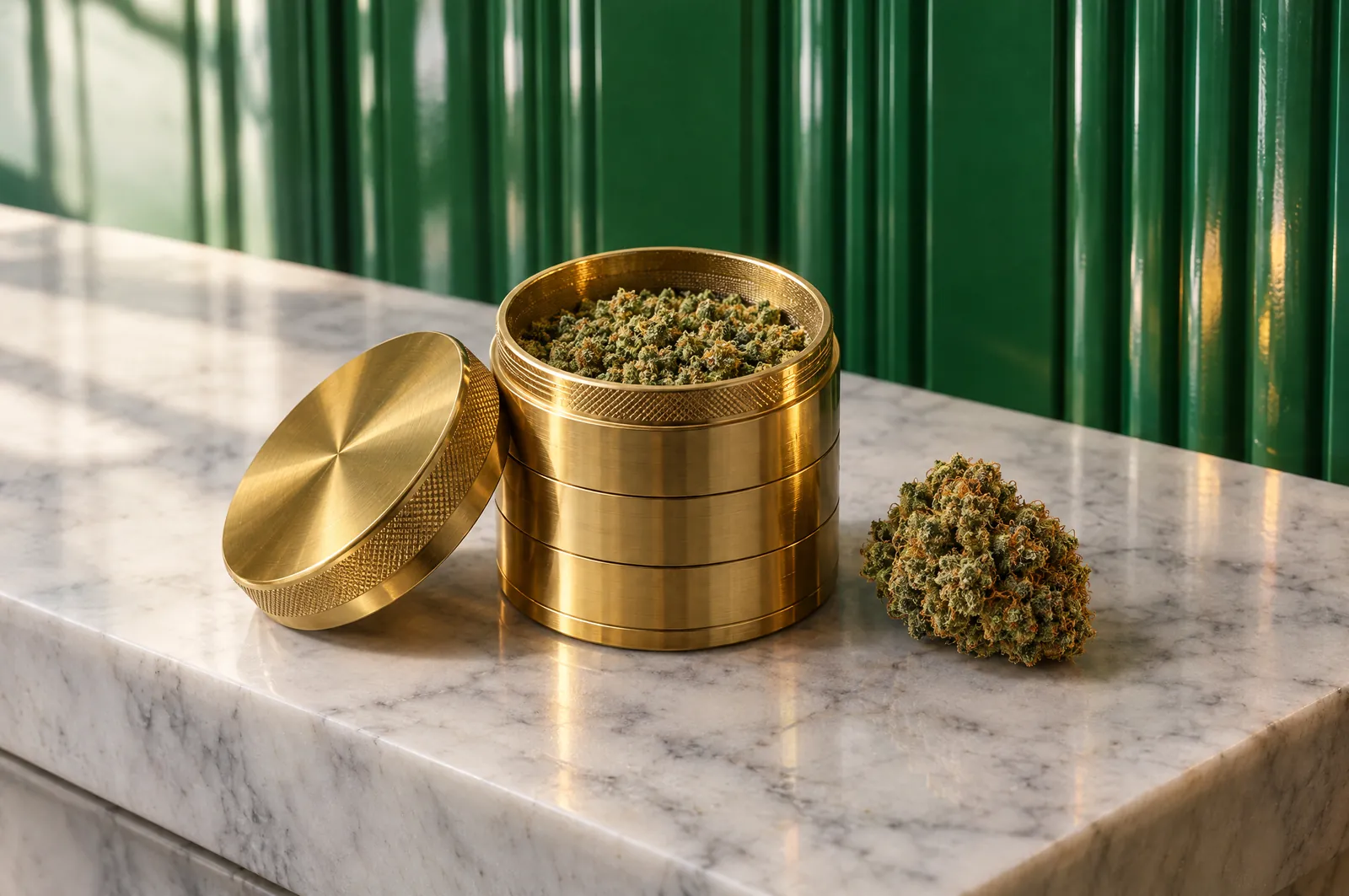
A four piece grinder has four working parts that each do one job
The lid is the top piece. Its underside carries a set of blunt pegs, usually called teeth or pins, that interlock with matching pegs in the chamber below. Many lids sit on a ring of small magnets so the two halves stay aligned while you turn them. The grip is knurled or ridged so your fingers do not slip once resin builds up.
Directly under the lid is the grinding chamber, where the flower actually breaks apart. In a two piece grinder, this is where the ground material stays and where you scoop it out. In a three or four piece grinder, the floor of that chamber is perforated, so pieces small enough to pass through drop into a collection chamber below. That collection chamber is where you take your ground flower from, and it usually unscrews from the rest.
Between the collection chamber and the bottom cup sits a fine mesh screen, often stainless steel. Only very small particles pass through it. The cup underneath is the kief catch, and it is the reason four piece grinders exist at all. Some models include a small scraper or plastic pick for lifting material out of that bottom cup.
Loading works best when you break buds down first and leave room to turn
Start by pulling the flower apart with your fingers into pieces roughly the size of a pea, then set the stem aside. Stems do not break down well, they wedge between the teeth, and they can lock the grinder mid turn. Removing them before loading saves you from prying the lid apart later.
Place those pieces in the ring of open space around the outer teeth rather than piling them in the center. The middle post area has the least clearance, and material stacked there tends to compress instead of shear. A common habit is to load enough for the session in front of you, not to fill the chamber to the brim.
Overfilling is the most frequent mistake. If flower sits above the level of the teeth, the lid will not seat, the two halves grind against packed material instead of moving it, and you end up with crushed clumps rather than even pieces. If the lid feels tight before you have turned it at all, open it and remove some material.
Ten back and forth turns is a reliable starting count
Hold the base steady in one hand and the lid in the other, then rotate back and forth in short half turns rather than spinning continuously in one direction. Reversing direction repositions the pieces against the teeth from different angles, which tends to produce a more uniform result than turning the same way over and over.
Count roughly ten of those half turns, then stop and open the lid. What you are looking for is loose, fluffy material with no large chunks and no fine dust. If you still feel resistance in your hand, material has not fallen through yet and a few more turns will help. If the grinder spins freely with no resistance, the chamber has likely emptied into the collection cup.
Grind length is a preference, not a rule. Shorter grinds leave a coarser texture that some people prefer for pipes, while longer grinds produce a finer texture some prefer for rolling. Grinding much past the point where resistance stops mostly produces powder, which packs tightly and restricts airflow.
An even grind burns more consistently than hand broken flower
Combustion follows airflow. When particle size is uniform, air moves through the material at a steady rate and the burn line stays even across the whole surface. When large chunks sit next to fine dust, air takes the path of least resistance around the dense spots, which is what produces the uneven burn commonly called canoeing or running.
The same principle applies inside a bowl. Coarse pieces leave large gaps that let air rush through unheated, while over ground powder compacts and chokes the draw. A medium, even grind sits in between and is why most people settle on that texture through trial and error rather than by measurement.
Even grinding also makes it easier to judge how much material you are using, because loose uniform flower fills a given space predictably. That matters more than it sounds, since consistency from one session to the next is largely a function of consistent preparation.
The kief catch collects trichome powder that falls through the screen
Kief is the fine, pale powder made up of trichome heads, the resin glands that grow on the surface of cannabis flower. Those heads are brittle when dry, so tumbling flower against grinder teeth knocks a portion of them loose. Anything small enough passes through the mesh screen and settles in the bottom cup.
Accumulation is slow. Depending on how often you grind and how resinous the flower is, a noticeable layer usually takes weeks of regular use rather than days. Some people speed it up by tapping the closed grinder on a hard surface after grinding, or by chilling it briefly first so the resin becomes more brittle and separates more readily.
Kief is more concentrated than the flower it came from, so people who use it typically add a very small amount, often sprinkled on top of ground flower in a bowl. Start with less than you think you need and wait before adding more. If you are new to cannabis, there is no requirement to use the kief catch at all.
Cleaning keeps the grinder turning freely, and One Green Leaf can point you to flower
Resin builds up on teeth, threads, and screens over time, which is what makes an older grinder feel stiff or gritty. A quick maintenance pass is to empty every chamber and brush the teeth and screen with a small dry brush, the kind sold for cleaning tools or a clean soft toothbrush. Doing that after each few uses prevents most buildup.
For a deeper clean, separate all the pieces and place metal parts in a container with isopropyl alcohol for a short soak, then scrub, rinse thoroughly with water, and let everything dry fully before reassembling. Check the manufacturer guidance first, since some plastic, wood, and coated grinders should not be soaked at all. Never grind or store flower in a grinder that is still damp.
One Green Leaf carries flower, vapes and carts, edibles, pre-rolls, concentrates, and wellness products such as tinctures and topicals, with a live Dutchie menu that updates in real time. You can shop in store, use the drive-thru, or reserve ahead for pickup. The shop is open every day from 9 AM to 9 PM in Gibbsboro, about 30 minutes from Philadelphia, and you must be 21 or older with a valid government photo ID. No medical card is required.
Adult-use cannabis in New Jersey may only be purchased by consumers 21 and older, who must present a valid government-issued photo ID at a licensed dispensary. No medical card is required for adult-use purchases.